The season of giving is here! If you’re looking for a thoughtful gift for a loved one with Parkinson’s, we’ve rounded up a list of ideas from our program advisors, who are living with the disease. Here are the top five most requested items this year:
Think exercise! Any kind of exercise equipment like a yoga mat, fitness tracker or reflective gear can make thoughtful gifts with many inexpensive options available. Or if you’re looking for something bigger, exercise machinery like a rower or recumbent bike helps your loved one get aerobic activity from the comfort of their home.
Comfort is key! Easy to wear clothing like slip on shoes, no button/zipper shirts, or faux jean, slip-on pants can help your loved one be comfortable. Or go for luxury with items like satin pajamas and sheets.
Self-care is a must have. Gift certificates for a massage or acupuncture can help your loved one unwind. Food delivery services, like a Hello Fresh subscription, can support a healthy diet while saving time in the grocery store and kitchen. Or if your loved one likes to engage in a little retail therapy, give them a gift certificate to their favorite store.
Practical is appreciated. Easy to use everyday gear like a pill box, shoehorn, fanny pack or sling bag can provide practical support to your loved one with Parkinson’s. There is also adaptive equipment to make eating and cooking a little easier. Check out our videos on eating and cooking to learn more about what’s available.
And the number 1, most requested item this holiday season, trekking poles! Often thought of as a hiking accessory, trekking poles can be used any time you go for a walk. They can also provide stability with at home exercises, such as static lunges. Trekking poles are a great way to increase aerobic activity while encouraging upright posture.
Bonus Idea!
A donation to the Brian Grant Foundation in honor of your loved one will help us give you – and many others – the gift of living well with Parkinson’s all year long. And this holiday season, you can send an ecard to your loved one to let them know that you gave a donation in their honor.
This Deep From 3 Bean Chili is rich with legumes, veggies, and spices. Look for pre-cut veggies to make this dish even easier to prepare. Make an extra helping for the freezer for a quick and easy meal.
Ingredients
1 can chickpeas
1 can black beans
1 can dark kidney beans
Tri-color peppers (prepped at store)
1/2 onions (prepped at store)
1 clove crushed garlic
1 can Tomatoes with Chiles, (Rotel) or 3 tomatoes diced
2 Tbsp chili powder
2 Tbsp Paprika
2 Tbsp Garlic powder
2 Tbsp Onion powder
Salt to taste
1 tbsp Pepper
4 cups chicken or vegetable stock
1 can tomato paste
Instructions
Chop onions and peppers and sauté with olive oil.
Add crushed garlic and continue to cook on medium so the veggies will sweat.
Season vegetables with chili powder, paprika, garlic powder, onion powder, salt, and pepper.
Strain all 3 beans and add to pot. Stir until all the seasonings are incorporated. Cook together for a few minutes. Add a little olive oil if it’s sticking to the pot.
Add 1/2 cup of water and tomato paste to pot and stir until it bubbles.
Add stock and cook on medium to medium low until the chili thickens.
Add “slurry” to it if you want a nice thick sheen. Wisk 1 tablespoon of corn starch and 1/2 cup of water in a separate bowl. Add to pot with stock.
This Deep From 3 Bean Chili brought to you by Chef Kenny James, personal chef to Blazers greats Damian Lillard and CJ McCollum, watch the video below as Chef Kenny takes you through a step-by-step process on how to prepare this healthy fall chili.
Watch Video
We offer our gratitude to the brave individuals who served in the U.S. military and are now facing a different kind of path – Parkinson’s disease.
In the U.S., an estimated 60,000 individuals are diagnosed with Parkinson’s disease (PD) each year. Of the nearly 1 million Americans believed to be living with the disease, an estimated 110,000 of them are veterans.
We have an obligation as a nation to honor and take care of the brave individuals who served in the U.S. military. This is why America has the most comprehensive system of assistance for veterans with Parkinson’s than any other nation in the world.
The U.S. Department of Veterans Affairs (VA) provides healthcare, home loans, insurance, disability compensation and other services to veterans.
To better address the needs of veterans with Parkinson’s disease, in 2000, the VHA established six Parkinson’s Disease Research, Education and Clinical Centers (PADRECCs) for clinical care, education and research in 2001.
The six PADRECCs are located in:
Los Angeles, California
San Francisco, California
Seattle, Washington
Portland, Oregon
Richmond, Virginia
Houston, Texas
Veterans who have been diagnosed with Parkinson’s disease and those who have just started to notice Parkinson’s-like symptoms are eligible for treatment at the PADRECCs. Typically, veterans are referred to a PADRECC or a Consortium Center by a consult from their VA primary care provider or general neurologist.
The PADRECCs also treat veterans with other types of movement disorders including dystonia, essential tremor, restless leg syndrome and atypical Parkinsonian disorders such as Lewy body disease, progressive supranuclear palsy and multiple system atrophy.
Veterans living with Parkinson’s disease or other movement disorders who are unable to travel to a PADRECC have the option of visiting one of 51 consortium centers, which are VA clinics staffed by movement disorder specialists or clinicians with vast experience and/or interest in the field of movement disorders. Click here for a full list of centers.
Pension extras and caregiver services
Did you know that if you receive a military pension and have Parkinson’s disease, you may be able to receive extra pension money? The two types of extra payment are Aid and Attendance (A&A) and Housebound. You can receive one or the other, but not both at the same time.
Housebound is when a permanent disability keeps you essentially limited to one place. A&A is when you need assistance with daily living activities such as getting dressed, if you are bedridden, living in a nursing home or if you have limited vision.
Veterans with PD may be able to receive a disability benefit, which is a monthly tax-free payment. The amount may vary if you have dependents or if you receive other military payments.
The VA also offers benefits for special events or situations, such as a temporary 100% disability compensation for hospitalization, recovering from a surgery or unemployment; allowance to buy a vehicle that could accommodate a disability; or even an annual clothing allowance for those who require a wheelchair, prosthetics or other assisted living devices.
Caregivers for veterans with PD also have access to help through the VA, including respite care for when caregivers need to take a break, adult day healthcare and long-term care in a veterans’ facility or a medical foster home, which is a private home with trained caregiver services.
In some cases, veterans with Parkinson’s may have developed the disease as a result of their service.
Evidence shows that one cause of Parkinson’s disease may be exposure to pesticides or herbicides. During the Vietnam War, many veterans were exposed to Agent Orange, a mix of herbicides that was used by the U.S. military to defoliate trees and remove concealment for the enemy.
Veterans exposed to Agent Orange during military service may be eligible for a free Agent Orange Health Registry Exam along with healthcare benefits and disability compensation. Vietnam veterans with Parkinson’s disease may claim benefits without having to prove that their conditions are due to Agent Orange exposure.
In January 2017, the VA issued a ruling making it easier for certain former service members with Parkinson’s disease (PD) to receive disability benefits. The decision applies to individuals who were exposed to contaminants at U.S. Marine Corps Base Camp Lejeune, North Carolina, from Aug. 1, 1953 to Dec. 31, 1987, and were later diagnosed with PD.
It should be noted that there are other causes of Parkinson’s disease, and many people who develop PD were never exposed to high levels of pesticides or herbicides. And there are many people currently living with Parkinson’s who have never served in the U.S. military.
For more information about healthcare, pension and other services for veterans with Parkinson’s, visit https://www.parkinsons.va.gov/.
Watch the recording of our Expert Q&A: Being a Caregiver with Maura Horton from November 9, 2021.
Thank you to our sponsors, Amneal and Kyowa Kirin, and to all of the generous donations that help support BGF programs.
Motivation is a two-way street for people with Parkinson’s and their care partners. Help each other live happily and healthily ever after by seeking opportunities to exercise together.
We already know that exercise is an important tool to help with the cognitive decline that people with Parkinson’s experience as the disease progresses.
But it’s also important to remember that those with Parkinson’s disease aren’t the only people whose brains benefit from a consistent fitness routine.
Research has found that everyone’s cognition starts to decline after the age of 40. That’s why engaging in an exercise program isn’t just good for people with Parkinson’s – it’s good for their spouse, partner, children and basically anyone else serving the role of care partner.
Exercise doesn’t just keep the body healthy – it keeps the brain healthy. When you work out, you’re constantly challenging your brain to communicate with other body parts to complete various physical tasks, whether it’s navigating around obstacles while jogging or throwing and catching a ball.
Completing physical activities that challenge cognition is very important for people with Parkinson’s because it helps sharpen their mental acuity and prolong their independence. Staying active helps us stay self-sufficient, which is something everyone wants to hold onto for as long as possible.
That’s why it’s so important for care partners to keep motivating their loved one with Parkinson’s to exercise.
There is strength in numbers
What’s the easiest way to motivate someone to exercise? It’s simple. You exercise with them.
Think of the care partner as a personal trainer whose job is to help their client find a physical activity they enjoy doing – whether it’s walking, dancing, playing racquet sports or bowling – and then join them in that activity.
Exercise is more fun when you have a buddy working out beside you – and it’s even more effective when you think of that buddy as a competitor. Don’t believe us? Just ask science!
Researchers at Kansas State University found that people who exercised with someone they thought was better than them increased their workout time and intensity by 200%.
We have the Köhler Effect to thank for this, which is the idea that a person works harder as a member of a group than when working alone. In fitness terms, this means we’re likely to push ourselves harder when working out with people we perceive to be in better physical shape.
Let’s say you’re gearing the family up for some friendly competition. When you announce, “Last one to finish carrying in the groceries is a rotten egg!” everyone is going to try their hardest not to be that rotten egg.
Had you simply asked, “Will you please carry in the groceries?” they still would have carried in the groceries, but they wouldn’t have been motivated to do it as quickly and effectively had you not challenged them to a competition. That’s the Köhler Effect kicking in.
The point is, when we work out together, we motivate ourselves to meet our fitness goals, while also motivating our loved one to meet theirs.
Thank you Mindy Simmons owner of Decadent Creations Bakery in Hillsboro for showing us how to make a delicious and healthier dessert that will satisfy your sweet tooth! Follow the directions below to make this decadent treat at home.
Stir together sugar, cornstarch and cocoa so there are no lumps.
In a saucepan, whisk together one can of coconut milk and sugar/cornstarch/cocoa and bring to a rolling boil. Stir frequently so the mixture doesn’t stick or burn.
Turn off heat and take saucepan off the heat to add dark chocolate chunks and 1 tsp vanilla. Whisk until combined and chocolate is completely melted.
Scoop chocolate mixture into dessert cups and chill for at least 2 hours.
Add optional toppings and enjoy!
Easy, delicious and healthy, these breakfast bowls can easily be modified to suit your tastes. Simply choose a favorite yogurt and granola and top with caramelized bananas, fruit, nuts, and a healthy sprinkle of flax, chia, and almonds.
Ingredients
3 Tbsp coconut oil
2 bananas, split lengthwise
Pinch cinnamon
2 cups granola
2 cups diary free yogurt (or other)
1 cup raspberries and blueberries
1 Tbsp crushed flax seed and chia seed mix
2 Tbsp toasted almonds, crushed
4 figs, split (or other seasonal fruit)
Drizzle of MCT oil
Instructions
Caramelized Bananas
In nonstick skillet, warm coconut oil over medium heat.
Add bananas, cut side down, and sear until golden brown (2 min).
Remove from pan and sprinkle with cinnamon.
Yogurt and Granola
Divide yogurt and granola among four bowls.
Top with berries, bananas (cut in half), flax/chia blend, almonds, fruit, and a drizzle of MCT oil as desired.
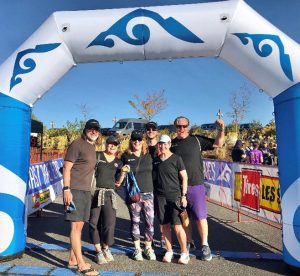
“Not today Parkinson’s” was the mantra of Team Rebounders as they finished 47 miles as a team in the High Desert Relay in Bend, Oregon on October 2, 2021. This mantra gave the 6-person team the power to finish, and finish with a vengeance.
High Desert Relay isn’t like any other 5k event; it’s a relay race with teams of four to six people covering 47 majestic miles in Central Oregon. It requires training, planning and teamwork from every team.
Team Rebounders isn’t like any other team; three members of their crew – Michelle Garrett, Cathie Baker and Kat Hill are also living with Parkinson’s. They were accompanied by their husbands and Michelle’s son, Hayden, to round out the team.
So “not today Parkinson’s” was just that. On race day the focus for this team was on teamwork and communication. It was proving that you can set a goal and absolutely crush it.
But the team wasn’t always so confident that they’d be able to participate in a 47-mile race.
“So many times, people with Parkinson’s think or say they can’t do something because of their disease,” says Kat.
That was true for Michelle, who had stopped participating in races because of her beginning stages, undiagnosed Parkinson’s symptoms. Though Michelle had been an avid runner and participated in many races, she retired her running shoes around 2014 because of intense pain and discomfort in her foot, caused by dystonia, which hadn’t been identified yet.
But Michelle decided to give the relay a shot, to help support the Brian Grant Foundation and get back to an activity that she loves. She formed Team Rebounders and recruited her friends, Cathie and Kat. They trained together and with the support of their husbands, participated in a once-in-a-lifetime 12-hour adventure.
Michelle had the 5am starting leg of the relay, in the darkness of the early morning. Michelle said, “the relay gave me a chance to face the demon of dystonia out there.” With her best friend and husband by her side, telling silly stories, she was reminded to “take in the moment.” She said, “it’s so rewarding knowing no matter how I was going to get there, I knew I was going to get there, even if I was crawling. Every day is an opportunity to win.”
Picture below is the team at the finish line. Left to right: Ken, Kat, Michelle, Hayden, Cathie, and Dan.
Fresh ahi tuna poke (poe-kay) is loved throughout Hawaii, combining sashimi grade fish with sesame oil, gluten free tamari, and a few simple seasonings for a deliciously easy meal. Served over sushi rice and surrounded by crisp vegetables and spicy edamame, poke is quickly winning fans here on the mainland as a fast and healthy meal.
Ingredients
Ahi Poke 1 lb. Ahi tuna, sashimi grade, ½” dice
½ tsp red chili flakes
¼ cup Tamari, gluten free
2 Tbsp sesame oil
1 Tbsp garlic, minced
¼ cup sweet yellow onion, finely sliced/shaved
¼ cup green onion, chopped fine
2 tsp sesame seeds, lightly toasted
2 tsp gomasio seasoning (optional) or dried seaweed, chopped
¼ head red cabbage, finely shredded
2 avocados, halved and sliced
2 watermelon (or other) radishes, peeled and sliced
Sushi Rice 1 cup sticky sushi rice
1.5 cups water
½ tsp salt
¼ cup seasoned rice vinegar
1.5 Tbsp sugar
Sesame Edamame 8 oz. edamame, frozen, shelled
3 Tbsp sesame oil
½ tsp shichimi togarashi (Japanese 7 spice) or pinch each of cayenne, salt and pepper
Instructions
Ahi Poke
Combine fish, chili flakes, tamari, oil, garlic, and sweet onion and mix well. Chill 15 min.
Serve cold over sushi rice, garnished with green onion, sesame seeds, avocado, red cabbage, radish, gomasio, and Sesame Edamame.
Sushi Rice
Rinse rice several times under cold water, soaking briefly between rinses, until water is clear.
Combine rice, water and salt in a small pot with tight fitting lid and bring to a boil. Cover tightly and turn heat down to low, cooking 20 min. until water is absorbed.
Meanwhile, combine vinegar and sugar; while rice is hot, stir vinegar mixture into rice gently. Serve immediately.
Sesame Edamame
Sauté all in skillet over medium heat until edamame begins to color, about 4 min. Serve hot.
This recipe is brought to you by Chef Greg Cabeza at Market of Choice.